Who it's forproject and delivery teams
“Who picked that up?”
With their yes, Recordist writes up your stand-ups and refinements on your own devices, with nothing joining the call.

Free, with no password. Your email brings your key for 7 days of Pro, with no card. By default, nothing is recorded until you say yes.
The browser demo is the real app with made-up meetings.
Summary
- Tickets talked about: The export ticket and the login timeout bug.
- What someone said is unclear, in their words: Natalie said of the export ticket, "It doesn't say what happens when an export has more than ten thousand rows."
- What someone said is in their way, in their words: Owen said he can have a fix for the login bug up by Friday "if I get access to the staging logs".
Action items
- Ask product about exports over ten thousand rows · You, today“I'll ask product about the ten thousand rows today” Time in call 03:10
- Write the test cases for the export ticket · Natalie, Thursday“I'll write the test cases by Thursday” Time in call 03:22
- Have a fix for the login bug up for review · Owen, Friday“I can have a fix up for review by Friday” Time in call 05:46
Open questions
- Can we size the export ticket before the criteria are settled?
Written with the notes, for you to read and send.
Recordist sends nothing, and the follow-up is yours to change and send from your own mail.
The follow-up comes with Pro, and every new install includes 7 days of Pro, with no card. On the Fast built-in model, no email is filled in for you. You tick the lines you want, and the draft is made from exactly those.
Follow-up draftPro
Hi Owen and Natalie, We went through the export ticket and the login timeout bug. Natalie said the export ticket doesn't say what happens when an export has more than ten thousand rows. Next steps: - I'll ask product about the ten thousand rows today and put the answer on the ticket. - Natalie will write the test cases by Thursday. - Owen will have a fix for the login bug up for review by Friday, if he gets access to the staging logs. Thanks,
Example, written by hand from the same staged call.
Ask Recordist for notes in this shape, with the template
- In Recordist, open Settings, then Templates, and press New template.
- Copy the three fields across, over the words already there. Leave summary and action items ticked, and tick questions and followup email as well.
- Press Save. To use it on every call, choose it under Settings, AI notes, Default template. For a call you have already recorded, choose it above the notes and press Regenerate.
Your own templates are on every plan, and the words are yours to change. How templates and the check against the transcript work.
Name
Team call
Short description
The tickets talked about, and who said they would do what.
Instructions for the model
Write the notes of a team call such as a stand-up, a refinement, sprint planning, a retro or a one-to-one. Write the summary as a list with exactly these labels, one short bullet each, and leave out a label nobody talked about:

- Tickets talked about:
- What someone said is unclear, in their words:
- What someone said is in their way, in their words:
- Next call:

The action items are what each person said they would do, with the day when one was said. Write only what was said. Never write that something was decided, agreed or concluded, and never judge anyone's work, pace or estimates.
-
Does a bot turn up in the stand-up?
No. Nothing joins the call and nothing appears in the participant list, on Teams, Google Meet, Zoom or a Slack huddle. Recordist works on your own devices, so the stand-up looks the same to everyone as it did yesterday.
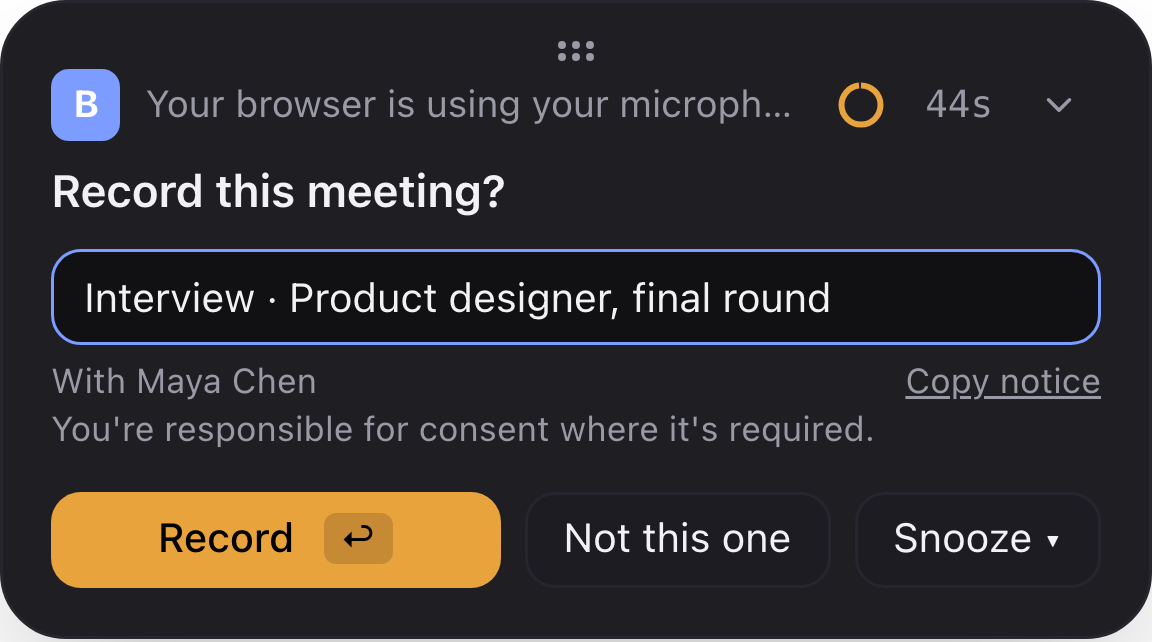
You still ask, because Recordist doesn't tell anyone it is there. One way to say it at the top of the call: "Before we start, is everyone happy for me to record this so I can listen instead of typing? The recording stays with me." If someone would rather not, click Not this one, and if someone joins partway through, ask again. The free consent script tool gives you the words and the rule for where everyone is.
The card that appears when a call starts. Nothing is recorded until you click Record, unless you have put that app on the automatic-recording list in Settings. -
What is the quickest way in, on a Meet or Teams call in the browser?
Add the free Recordist extension from the Chrome Web Store, join the call in Chrome and press Start transcript. A live transcript builds up in the side panel beside the call, with the names the captions show, so you can follow who said what while the stand-up is still going. It starts only when you press Start, and it reads the meeting's own captions, so captions need to be on in that call.
The transcript is kept in your browser, to copy, download or delete when the call ends. Get notes from this call, in the panel, hands it to the Recordist app, which writes the notes. The guides for Google Meet and Teams in the browser show each step.
-
And for a Slack huddle, or Teams and Zoom in their desktop apps?
Use the free Recordist app, from the download page. When a huddle or a call starts using your microphone, a small card asks "Record this meeting?", and by default nothing is recorded until you click Record. It hears your microphone and the sound of the call on your own devices, so it needs no captions, no plugin and no setting from whoever hosts.
There is nothing to add to Slack. Recordist doesn't connect to Slack at all, and it hears a huddle the way it hears any other call. When the call ends the transcript is ready, and the notes follow a few minutes later.
-
Who said they would take the login bug?
The notes list who said they would do what, each with a due day when one was said out loud, and the sample above shows the words each promise was made in. Before the notes are saved, an owner or a day the transcript doesn't state outright is labelled as worked out, so you know to check it.
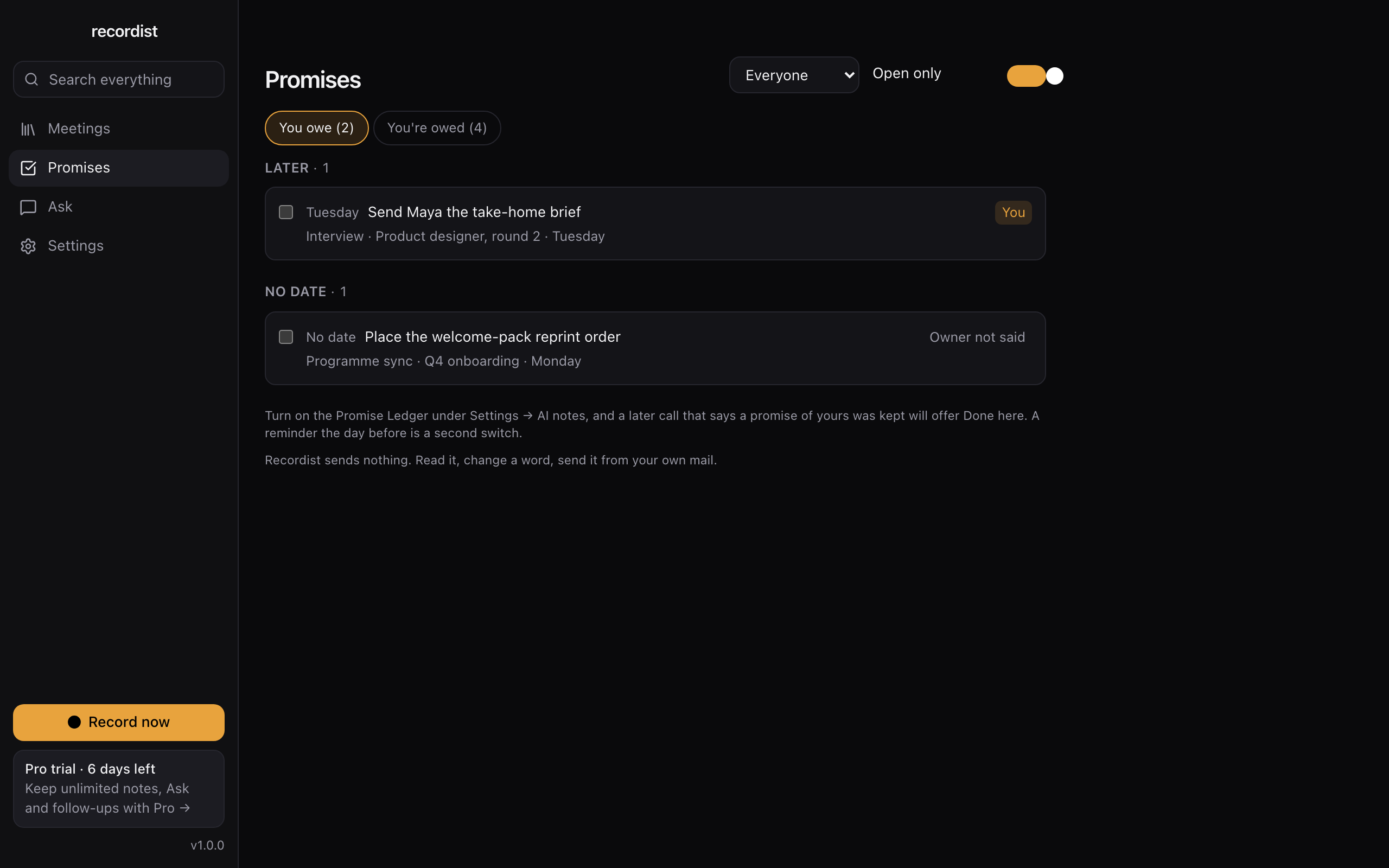
Promises collects the open ones from every meeting with notes, in two lists, what you owe and what you're owed, grouped by Overdue, Today, This week and Later, with the meeting each one came from and the words it was made in. So when someone asks on Thursday who picked that up, the answer is there in the words they used.
Promises from every meeting in two lists, what you owe and what you're owed, each with the meeting it was made in. The real app, shown with made-up people and meetings. -
What did QA say was missing from the acceptance criteria?
Type a word such as "criteria" or "export", and Recordist lists every meeting where it was said, with the sentence and the time. Click a result to open the meeting at that line, then click the time to hear it while the audio is kept. The search index is stored on your devices and works offline.
On Pro, Ask puts a plain question to your recent meetings, such as "what did Natalie say about the export ticket?", and the answer names the meeting and the time it comes from.
-
Will the notes say what we decided?
They say what was said. The template on this page asks for the tickets talked about, what someone said was unclear or in their way, in their own words, and who said they would do what. It tells the notes never to write that something was decided or agreed, because a refinement often ends on a nod, and a nod never reaches the transcript.
When a choice matters, say it out loud, and the notes will have it in the words you used. They can still be wrong, so read them against the transcript before you post them in the team channel. Clicking any line of the transcript plays that moment.
-
There are six of us on the call. Who is labelled as who?
Your microphone is labelled You. In a desktop app, such as Teams, Zoom or a Slack huddle, everyone else on the call shares one label, which you can rename for each meeting. Naming people as you hand out work, as in "Owen, is that you?", gives the notes an owner to write down.
In a browser call, the extension's live transcript carries the names the captions show, and on Pro the Chrome extension can name each line in the app's transcript from what the meeting page shows, once you turn it on.
In a stand-up around one table, every voice reaches the one microphone, so every line is labelled You. Check the recording before you quote anyone.
-
Can it get me ready for my one-to-ones?
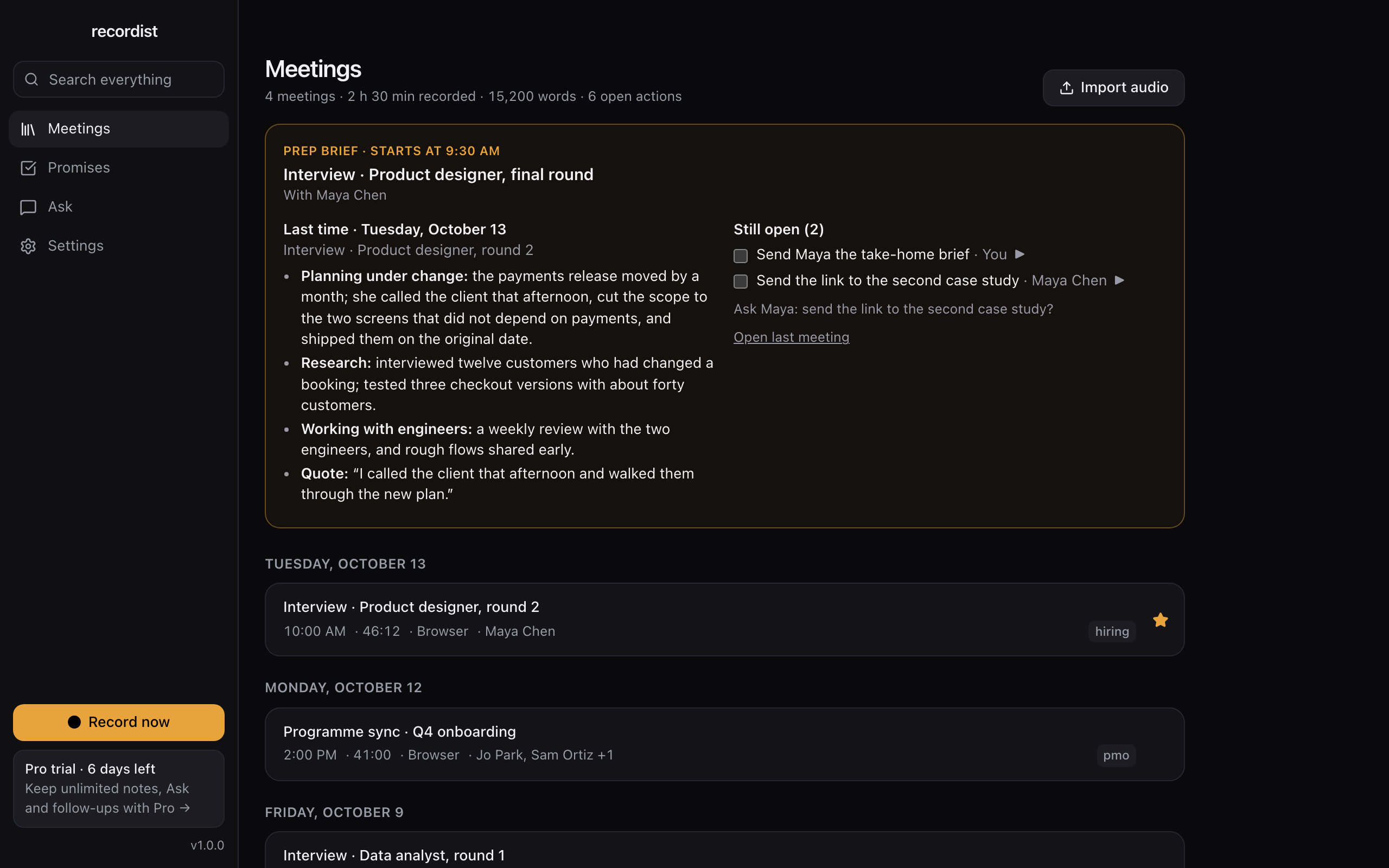
Yes, on Pro, when the call is in your calendar. Up to 45 minutes before a call with someone you have met before, a Prep Brief shows the moments from last time, a summary of that meeting and the action items still open on both sides, so you start from what they said they would do and what you said you would. It works from your Mac's calendar or a calendar feed.
It finds earlier meetings by the attendees' names, so two people with the same first name can end up in one brief. The built-in 1:1 template asks for feedback, career topics and what each side committed to, and it asks the notes never to describe anyone's mood, health or personal life. A one-to-one is personal, so ask first, and leave it unrecorded whenever someone would rather talk freely.
See the Prep Brief in the demo
Every meeting you record, in one list, with a brief before the next one. The real app, shown with made-up people and meetings. -
I want a buddy for my calls, someone I can rely on. Is that what this is?
It is there when you ask it to be. By default Recordist asks before every call, and the extension starts only when you press Start transcript. Once you say yes, it keeps every word of that call with you, writes down who said they would do what, and has it ready the next time someone asks what was said on Tuesday.
It won't tell you what the team decided. It keeps what each person said, and the time beside each line plays it again while the audio is kept.
-
Where do the recordings and notes go?
They are kept with you. With the built-in engine, the audio, transcript and notes stay on your own devices, and no AI service sees them. There is no account, and we never receive your audio. The Privacy Ledger in the app lists the network requests it makes, apart from a few kinds listed in Help, none of which carries meeting content. If you choose a cloud AI provider for notes in Settings, the transcript goes to that provider under its terms, and that is off until you set it up.
If you work on a client's project, their contract or NDA may say whether you may record at all, and if it does, it decides. The page for IT, security and legal reviewers answers what their IT will ask, and you can forward it.
-
What does it cost?
Recording, transcription, search and export are free. AI notes are unlimited during your 7 days of Pro, which begin with your email when Recordist first opens and then 3 a month. Pro removes that limit and adds Prep Briefs before you meet someone again. Its price is on the pricing page, and if you subscribe at the launch price, it stays the same for as long as you stay subscribed.