Who it's forcoaches
“What did I say I would do?”
Your client opens the session with that question, and you are turning pages in a notebook from three weeks ago. With their yes, Recordist records the session on your own machine, with nothing joining the call, and writes up what they brought and what they said they would do, in their words. You get to look at them for the whole hour, and the record stays with you.
The browser demo is the real app with made-up meetings. Nothing is recorded.
Summary
- What the client brought: The board presentation, which she keeps taking back from her team and rewriting herself.
- What gets in the way, in their words: "I don't trust the first draft. If it's wrong, it's my name on it."
- What they want to be different by next session: Marcus presents the numbers section himself, and she does not touch his slides.
- Next session: The nineteenth, same time.
Action items
- Tell Marcus that the numbers section is his · Emily, Monday Time in call 44:07
- Read his draft once and give comments in one pass · Emily, Thursday Time in call 44:19
- Send the delegation worksheet · You, tomorrow Time in call 46:35
The follow-up
Written with the notes, for you to read and send.
The draft is written from what was said on the call, and it is yours to read, change and send from your own mail. Recordist sends nothing. The follow-up comes with Pro, and every new install includes 7 days of Pro, with no card.
On the Fast built-in model, no email is filled in for you. You tick the lines you want, and the draft is made from exactly those.
Follow-up draftPro
Hi Emily, You brought the board presentation, which you keep taking back from your team and rewriting yourself. You want Marcus to present the numbers section himself, and you don't want to touch his slides. Next steps: - You'll tell Marcus on Monday that the numbers section is his. - You'll read his draft once on Thursday morning and give him comments in one pass. - I'll send you the delegation worksheet tomorrow. Thanks,
Example, written by hand from the same staged call.
The template
Ask Recordist for notes in this shape.
- In Recordist, open Settings, then Templates, and press New template.
- Copy the three fields across, over the words already there. Leave summary and action items ticked, and tick followup email as well.
- Press Save. To use it on every call, choose it under Settings, AI notes, Default template. For a call you have already recorded, choose it above the notes and press Regenerate.
Your own templates are on every plan, and the words are yours to change. How templates and the check against the transcript work.
Name
Coaching session
Short description
What the client brought, and what they said they will do.
Instructions for the model
Write the notes a coach keeps after a session. Write the summary as a list with exactly these labels, one short bullet each, and leave out a label nobody talked about:

- What the client brought:
- What gets in the way, in their words:
- What they want to be different by next session:
- Next session:

The action items are what the client said they will do before the next session, and anything the coach said they would send. Do not give advice of your own, do not diagnose or judge anyone, and in the notes and the email do not describe anyone's mood, health or personal life.
01
Recordist runs on Macs with Apple silicon and macOS 14.6 or later, on 64-bit Windows 10 or 11, and on x86_64 Linux, all free from the download page.
02
There is no account, and we never receive your audio. The Privacy Ledger in the app lists the network requests it makes, apart from a few kinds listed in Help, none of which carries meeting content.
03
Nothing joins the call and nothing tells the other person, so you ask out loud and click Record after a yes. The free consent script tool gives you the words for where you both are.
04
Recording, transcription, search and export are free. AI notes are unlimited during your 7 days of Pro and then 3 a month. Pro removes that limit and adds Prep Briefs before you meet someone again. Its price is on the pricing page, and if you subscribe at the launch price, it stays the same for as long as you stay subscribed.
-
How do I ask a client if I can record?
Ask out loud at the start, every time, and click Record after a yes. Recordist doesn't tell the other person that it is recording, and it can't ask them. One way to say it: "Are you happy for me to record this so I can listen properly? The recording stays with me, and we can stop whenever you like."
You may want it in your coaching agreement as well. If a client says no, click Not this one. If they change their mind partway through, stop the recording and delete the call afterwards. The free consent script tool gives you the words and the rule for where you both are.
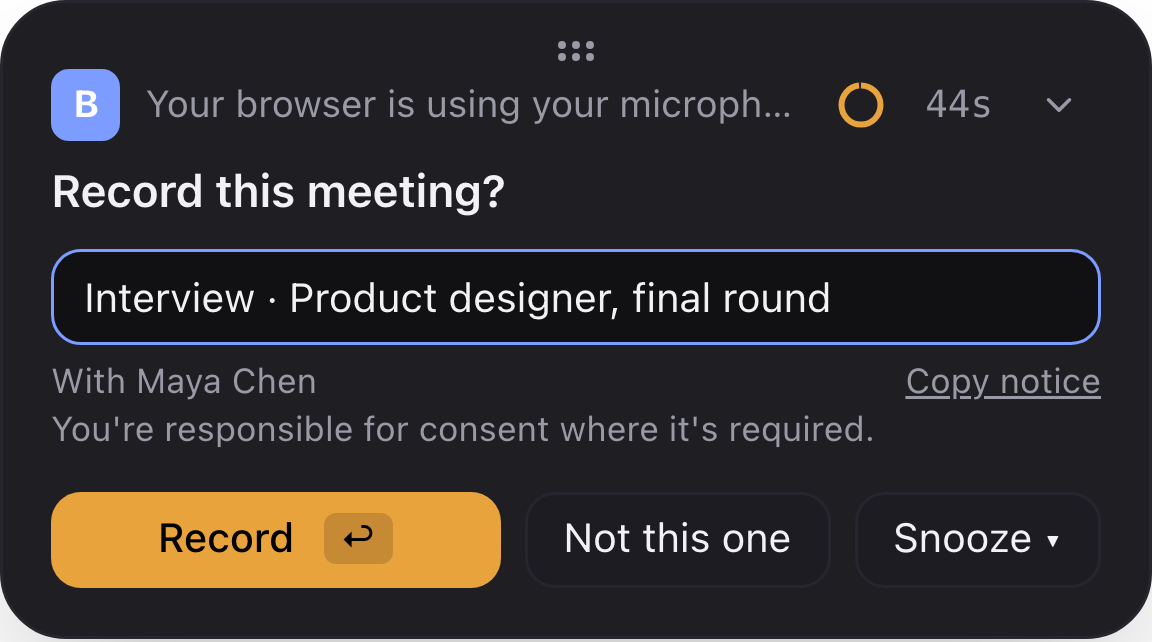
The card that appears when a call starts. Nothing is recorded until you click Record, unless you have put that app on the automatic-recording list in Settings. -
Does anything show up on my client's screen?
No. Recordist listens on your own machine, to your microphone and the sound of the call, so nothing appears in the participant list and the session looks the same to your client. That is why the asking has to come from you.
-
What do the notes say about my client?
The template above asks for what they brought, what gets in the way in their words, what they want to be different and when you next meet. The action items are what they said they would do, each with the line it came from.
It tells the notes to give no advice of their own, to diagnose and judge nobody, and to leave out anyone's mood, health and personal life. Notes can miss an instruction like this, so read them before you keep them.
-
What did she say three sessions ago?
Type a word such as "delegate" or "board", and Recordist lists every session where it was said, with the sentence and the time. Click a result to open the session at that line, then click the time to hear it while the audio is kept. The search index stays on your own machine and works offline.
-
Can one client's words turn up in another's?
Not when each session is filed under its client. Give each client a place in Clients and file the sessions there. Inside a client, search and Ask read only that client's calls, and outside one, search reads only what isn't filed until you press Search every client too. Nothing is filed until you say so, and filing is on every plan with no limit.
-
Can it help me prepare for the next session?
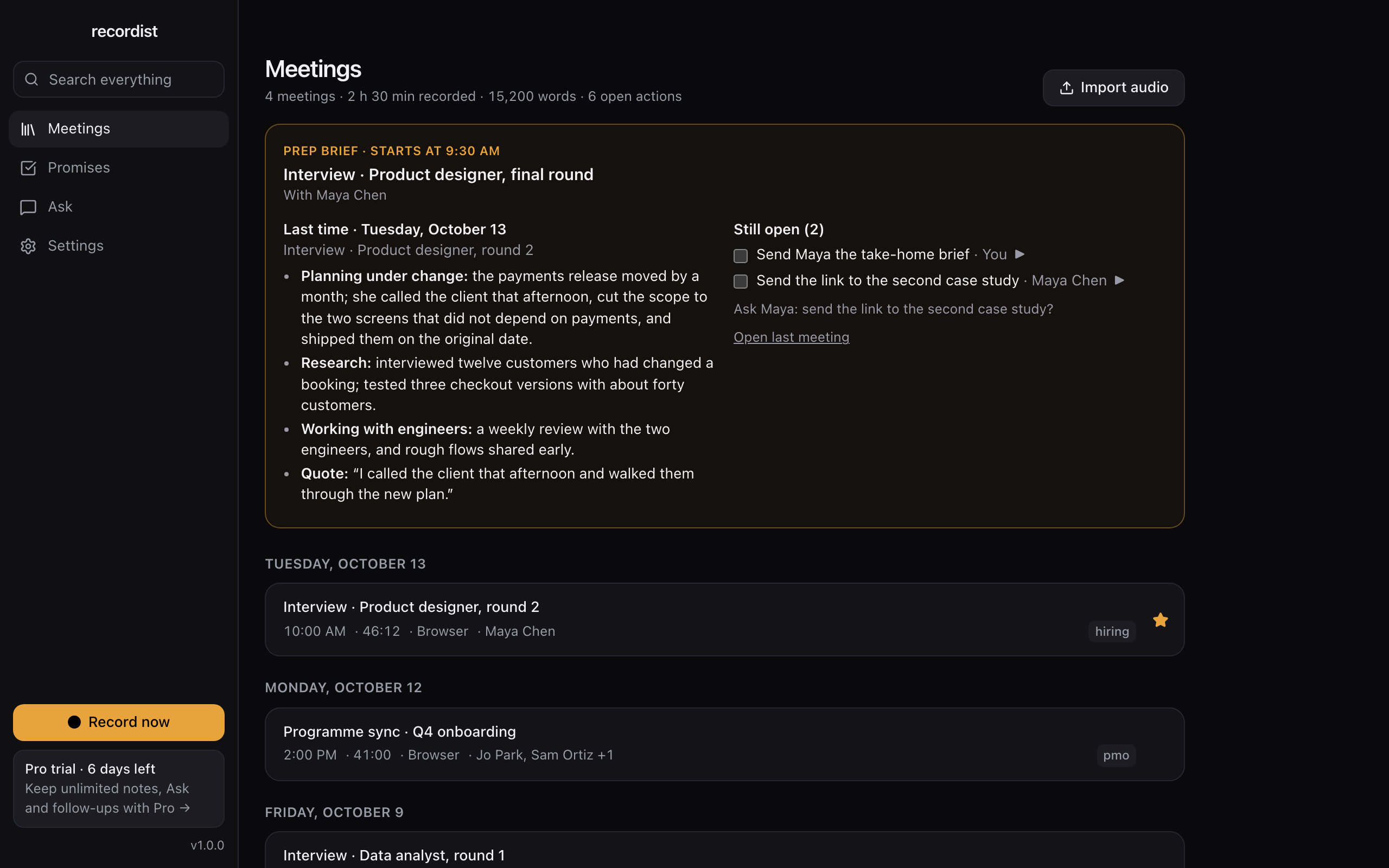
Yes, on Pro, when the session is in your calendar. Up to 45 minutes before a call with someone you have met before, a Prep Brief shows what you decided last time, a summary of that meeting and the action items still open on both sides. It works from your Mac's calendar or a calendar feed.
It finds earlier sessions by the attendees' names, so two clients with the same first name can end up in one brief. Glance at it before you share your screen.
See the Prep Brief in the demo
Every meeting you record, in one list, with a brief before the next one. The real app, shown with made-up people and meetings. -
Who can see these recordings?
With the built-in engine, the audio, transcript and notes stay with you, and no AI service sees them. There is no account, and we never receive your audio. The Privacy Ledger in the app lists the network requests it makes, apart from a few kinds listed in Help, none of which carries meeting content.
Anyone who can sign in to your account on that machine can open the app, so keep that login to yourself and your disk encryption on. If you choose a cloud AI provider for notes in Settings, the transcript goes to that provider under its terms, and an AI assistant you connect yourself can read your library. For sessions, leave the built-in engine on and leave assistants unconnected.
-
Can I use it for therapy, or when health comes up?
Recordist isn't made for therapy or clinical sessions, and if that is your work, this page says why. If a coaching session turns to someone's health, you can stop the recording and delete the call afterwards.
-
Can the notes be wrong?
Yes. Read them against the transcript before you rely on them, and click any line of the transcript to hear that moment while the audio is kept. An owner or a date the transcript doesn't state is left blank.
-
What does it cost?
Recording, transcription, search and export are free. AI notes are unlimited during your 7 days of Pro and then 3 a month. Pro removes that limit and adds Prep Briefs before you meet someone again. Its price is on the pricing page, and if you subscribe at the launch price, it stays the same for as long as you stay subscribed.
-
How do I start?
Download it, paste the template above, and record a practice session with a friend or a colleague. Read what comes out. Then ask the next client you think would be comfortable, and keep your own notes alongside until you trust it.
Next
What to do next.
Two minutes
Click around the real app
Open a sample interview, search for a word and tick a promise done, in your browser.
Free tool
How to ask to record a call
The words to say, and the rule where you and the other person are.
Free to start
Try it on your next call
Recordist is free to download for Mac, Windows and Linux. It needs no account and no email, and the 7 days of Pro include every Pro feature. Keep your own notes on anything that matters until you trust it.
Also for
Other kinds of work.
Consultants
Your client remembers the call one way and you remember it another, and the scope is somewhere in between.
Startup founders
Customer calls, investor calls and hiring calls in the same week, and the detail you need is always from the one you didn't write down.
Recruiters
Four candidate calls before lunch, and by Thursday your client wants to know exactly what the second one said about notice.
HR and recruiting
Fifteen interviews a week, and the hiring manager wants to know exactly what the candidate said.
Lawyers
You want a record of the call, and you also have to answer for where that record is kept.
Therapists and counsellors
Recordist is not made for therapy sessions or calls about clients. This page explains why.
The summary for IT, security and legal reviewers Every page, or four questions to find yours